

Adam Scott, MS CSCS
Every winter over 2 million individuals in North America pilot a snow mobile. At the very top end of this group are Snowmobile Hill Climb racers.
MTI has been working with hill climb racers for years. During that time not a single study examining the physical demands facing our athletes has been published. Frustrated with the lack of information, we decided to strap our Zephyr Bioharnesses and Athos Surface Electromyography (sEMG) garments on a few of our athletes and complete our own case study.
The study took place during a Rocky Mountain States Hillclimb Association (RMSHA) competition in Afton, WY a few weeks ago. What we found was pretty illuminating. For example, our study showed our athletes hitting speeds around 25mph while climbing 45% inclines and pulling 2 g’s of acceleration…all at 85% max heart rates. Below is a link to the full study, as well as a brief summary of our results.
READ THE FULL ARTICLE: MTI Case Study White Paper
SUMMARY:
1-1. Purpose
To date, not a single study could be found which assessed the physical and physiological demands of Snowmobile Hill Climbing. The purpose of this study was to quantify the demands faced by our snowmobile athletes so that we can better prepare them for their competitions.
1-2. Subjects & Event
Both case study subjects were experienced hill climb racers. The male athlete (35 years old) had just over two years of competitive experience and the female (32 years old), a professional, had four years of racing experience.
All races were completed between 26-28 FEB, 2016 in Afton, WY. The competition was part of the 2016 Rocky Mountain States Hill Climb Association race series. Race Link
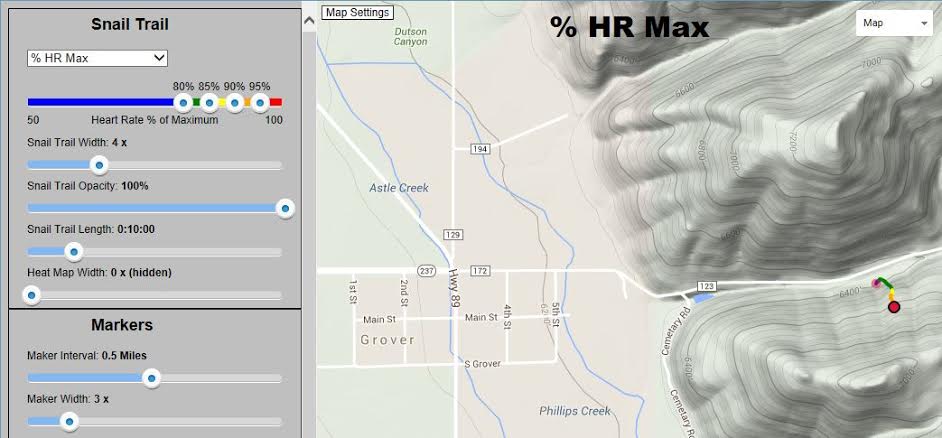
Example of GPS and Physiological Data collected during race trial (Zephyr Bioharness)
1-3. Design
This case study was conducted in two parts. The first looked specifically at race and physiological data. The second assessed muscle activation.
Part I: Race and athlete data was collected over the course of four hill climb trials – two for each athlete. During all four trials the athletes wore a Medtronic Zephyr Bioharness 3.0 (Model BH3) which collected physiological and GPS data.
Part II: During a single trial MTI collected a snapshot of muscle activation data using Athos Surface Electromyography (sEMG) garments.
1-4. Results & Discussion
Part I: Found that Hill Climb race data varied greatly depending on the course and the athlete. However, our four trials produced the following averages: Hill Grade Incline = 44.5%; Time = 33.0 sec; Horizontal Distance = .14 miles; Elevation covered: 338.1 ft; Max Speed = 23.7 mph; Average Speed = 13.8 mph.
Physiologically, our data showed that both our male and female athletes were competing at over 80% of their max HR (84.4% and 84.2% respectively). Subjects also experienced a 42.5% and 55.3% increase in their breathing rate and a 41.4% and 44.6% decrease in their HRV, respectively. This decrease in HRV is indicative of increased sympathetic nervous system activation, often characterized by “fight or flight” decision making in times of high stress.
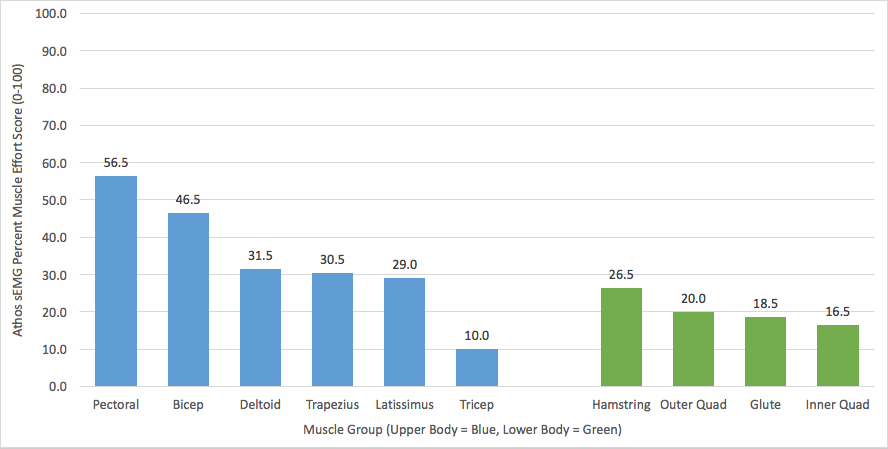
Our study also found that, although the posterior muscle groups were slightly more active (4-5%), our rider’s muscle activity was fairly even between anterior and posterior muscle groups in both the upper and lower body.
Upper and Lower Body Muscle Activation (PME score)
1-5. Conclusion and Recommendations
Based on the data collected during this case study MTI makes the following conclusions and recommendations for applying the information.
2. Balanced (pushing and pulling) upper body muscular endurance is a major component of Snowmobile Hill Climb race performance. Recommendation: Based on this MTI would recommend strength training which utilized higher rep ranges and loads of between 50-60% 1RM. Additionally, strength training should also pair pushing and pulling movements whenever possible. Finally, based on the previous research we reviewed, vibration-based training could also serve as a valuable tool.
3. Finding the right balance of psychophysiological stress, as measured by HRV, should have a positive effect on hill climb performance. We found that both athletes had their worst performances during their lowest HRV measures. This seems to hint at a “sweet shot” between too much stress and too little – which is fairly common in extreme activities. Finding that spot can be extremely complicated and definitely needs additional research focus.
REFERENCES
(1) Pierz, J. Snowmobile injuries in North America. Clinical Orthopaedics and Related Research, 409, 29-36, 2003.
(2) Anttonen, H. and Niskanen, J. Whole body vibration and the snowmobile. Arctic Medical Research, 53(3), 24-28, 1994a.
(3) Antonnen,H. and Virokannas, H. Hand-arm vibration in snowmobile drivers. Arctic Medical Research, 53(3), 19-23, 1994b.
(4) Kjellberg, A., Wikstrom, B. Whole-body vibration: exposure time and acute effects – a review. Ergonomics, 28(3), 535-544, 1985.
(5) Torvinen, S; Kannus, P; Sievanen, H; Jarvinen, T; Pasanen, M; Kontulainen, S; Jarvinen, T; Jarvinen, M; Oja, P and Vuori, I. Effect of a vibration exposure on muscular performance and body balance. Randomized cross-over study. Clinical Physiology and Functional Imaging, 22(2), 145-152, 2002.
(6) Astom, C; Rehn, B; Lundstrom, R; Nilsson, T; Burstrom, L and Sundelin, G. Hand-arm vibration syndrome (HAVS) and musculoskeletal symptoms in the neck and the upper limbs in professional driver of terrain vehicles – A cross sectional study. Applied Ergonomics 37, 793-799, 2006.
(7) Nayha, S; Antonnen, H and Hassi, J. Snowmobile driving and symptoms of the locomotive organs. Arctic Medical Research, 53(3), 41-44, 1994.
(8) Heisler, E. The Relationship of snowmobile year, track length, and riding terrain to the occurrence of musculosketetal symptoms in recreational snowmobile drivers. UNLV Theses/Dissertations/Professional Papers/Capstones. Paper 766, 2010.
(9) Rehn, B; Bergdahl, C; Ahlegran, C; From, C; Jarvholm, B; Lundstrom, R; Nilsson, T and Sundelin, G. Musculoskeletal Symptoms among Drivers of All-Terrain Vehicles. Journal of Sound and Vibration 253(1), 21-29, 2002.
(10) Mayo Clinic Staff. Tests and Procedures: Electromyography (EMG). http://www.mayoclinic.org/tests-procedures/electroconvulsive-therapy/basics/definition/prc-20014183. Oct 25, 2012. Accessed: Feb 02, 2016.
(11) 14-15 International Snowmobile Racing Inc. Rules – Copyright 2014 GENERAL RULES AND REGULATIONS.
(12) Nunan, D; Gavin, R; Sandercock, H and Brodie, D. A quantitative systematic review of normal values for short-term heart rate variability in health adults. Pacing Clin Electrophysiol. 33(11):1407-1417, 2010.