

By Rob Shaul, Founder
MTI has two separate offerings to train “base fitness” for Wildland Firefighters: (1) 5 individual Wildland Fire base fitness training plans, and; (2) the Wildland Fire sessions.
Each of the 5 plans can be purchased individually and each plan is 7 weeks long. The Wildand Fire Sessions are only available with an Athlete’s Subscription, and the cycles are changed monthly, each being 4 or 5 weeks long depending on the month.
MTI’s Base Fitness programming for Wildland Firefighters trains the following fitness attributes concurrently using MTI’s Fluid Periodization methodology. “Base Fitness” is built for day-to-day training either during down times during the fire season, or the off season, and is designed to address 90% of the fitness demands of fighting wildland fighters.
- Relative Strength
- Work Capacity (sprint-based and multi-modal)
- Chassis Integrity (functional core)
- Mountain Endurance (run, ruck, loaded uphill)
Work through the plans in the order below, finishing with the appropriate pre-season training plan (Wildland Fire Pre-Season for truck crews, Hotshot/Smokejumper Pre-season for hotshots and smokejumpers) directly prior to reporting for the fire season in the Spring.
All of MTI’s Wildland Fire training plans have a significant endurance emphasis – which reflects the mission-direct fitness demands of wildland firefighting, and the fitness culture of most wildland fire units.
The endurance programming in the plans is progressed as you work through the plans. This means the endurance distances increase from plan to plan.
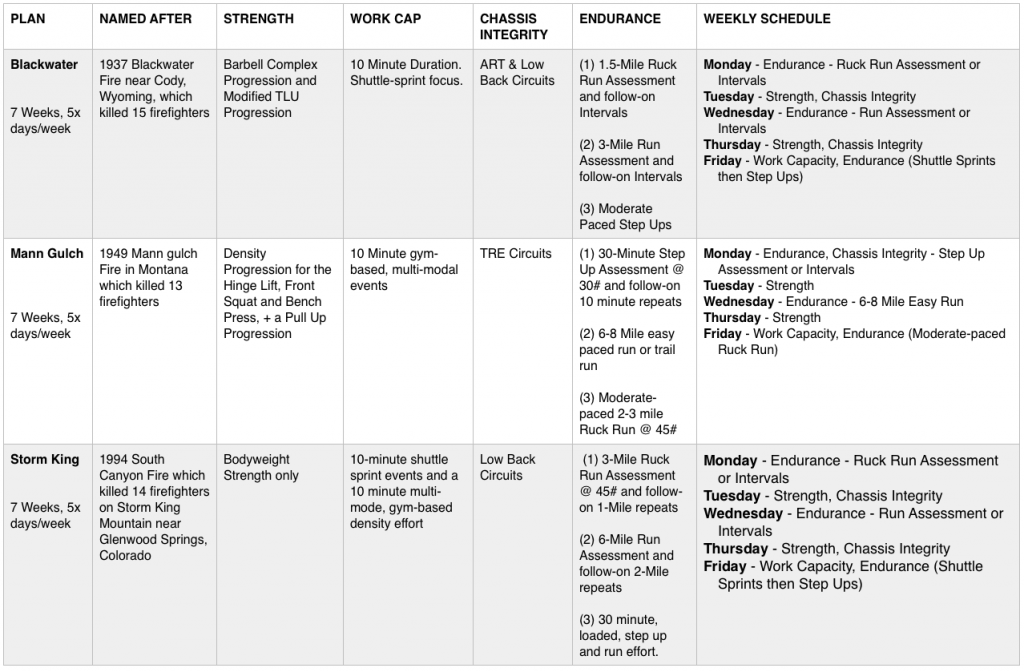
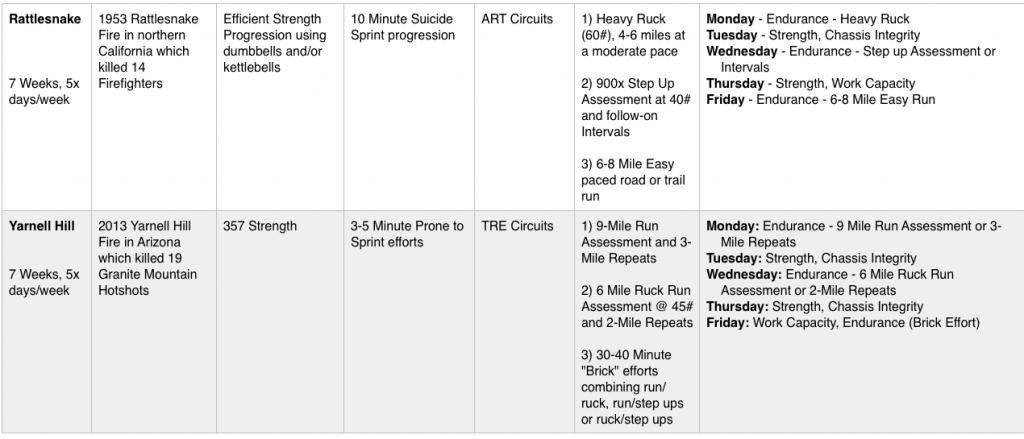
These 5 plans weree named after tragic wildland fires from America’s past. (Click HERE if you want to learn more about why I named these plans after these tragic fires.)
Yarnell Hill
Named after the 2013 Yarnell Hill Fire in Arizona, which took the lives of 19 Granite Mountain Hotshots.
Blackwater
Named after the Blackwater Fire of 1937, near Cody, Wyoming, which killed fifteen firefighters. Investigations and analysis of the event led the USFS to develop better ways to provide a more immediate response to combat fires; one of them was the development of the smokejumper program in 1939.
Mann Gulch
Named after the 1949 Mann Gulch Fire along the Upper Missouri River in Montana which killed 13 wildland firefighters, including 12 smokejumpers. Norman Maclean’s book, Young Men and Fire, is based on Mann Gulch.
Storm King
Named after the South Canyon Fire of 1994, that took the lives of 14 wildland firefighters on Storm King Mountain, near Glenwood Springs, Colorado.
Rattlesnake
Named after the Rattlesnake Fire of 1953 in northern California, which took the lives of 14 volunteer firefighters from the New Tribes Mission. The incident was chronicled in John Maclean’s 2018 book, River of Fire.
Click the links below for the specifics of each training plan:
See the Chart Below for details on the Killer Fire Plans:
The price for this packet of plans represents a 25% savings over the combined price of the individual plans.
Required Equipment
- Fully-Equipped Functional Fitness Gym
- Ruck or Backpack and up to 60# of load
- 10# dumbbell, sledgehammer, hoe or other wildland fire hand tool
You can also click on the individual plans above to see the required equipment for each specific training plan.
Common Questions
What order should the plans be completed?
What if I miss a day?
Begin where you left off when you return to training. This program is progressed – each session builds upon the prior session – so don’t skip a session or skip around. Follow the training sessions in order, regardless.
What if I can’t do the whole session?If you don’t have enough time to complete the whole session, you can split the session into two.
What is the difference between the Greek Hero plans and the Virtue Series Plans?
1. The training plans in both series were both initially completed by our tactical lab rats, including myself, at our facility in Wyoming. The Greek Hero Series deploys our most recent programming. The Virtue Series deploys our previous version.
2. Both Series are designed as day to day programming for tactical athletes. The Virtue Series concurrently trains strength, work capacity, endurance, and chassis integrity. The Greek Hero Series trains these attributes plus TAC SEPA (tactical speed, explosive power, and agility).
3. Each plan in the Virtue Series trains these attributes concurrently, but each also emphasizes certain attributes. Fortitude, for example, emphasizes gym-based strength and moderate-paced mid-distance endurance. Some of the Greek Hero plans likewise have areas of emphasis, but it is more subtle.
The more defined emphasis in the Virtue Series allows me to target these plans to athletes relatively new to our programming, or who need to work on specific areas.
In general, the Virtue programming is simpler, more direct and more “jagged.”
As tools, I can deploy for athletes the Virtue plans are a little more blunt. The Greek Hero plans are more fluid, subtle and sophisticated.
The Virtue Plans make a great foundation for the Greek Hero plans.
What about nutrition?
See our Nutritional Guidelines HERE.
Where do I find unfamiliar exercises?
See our Exercise Library HERE. The Run/Ruck Calculators are listed as an exercise.
What do you mean by 15 Minute “Grind”?
You should work your way through these circuits briskly not frantically.
Can I see sample training?
Yes – click on each individual training plan above, then click the “Sample Training” tab at the plan product page to see sample training.
How do I access the plan?
You can access the plan via username and password either through our website or through our app ((Mtn Tactical Fitness) available for IOS and Android.
Can I print out sessions to take to the gym?
Yes – you can print a week of programming at a time.
More questions? Email coach@mtntactical.com
Disclaimer
Before beginning any exercise program, consult with your physician to ensure that you are in proper health. Physical training contains inherent risks including, but not limited to, muscle strains, tears, physical and bodily injury up to and including death. This training program is not meant to provide medical advice; you should obtain medical advice from your private health care practitioner. If you are unable to assume these risks then you should not engage in this training program. No liability is assumed by Mountain Tactical Institute, Inc, its owners or employees, and you train at your own risk. Mountain Tactical Institute makes no warranty, express or implied, of any kind in connection with this training program.