
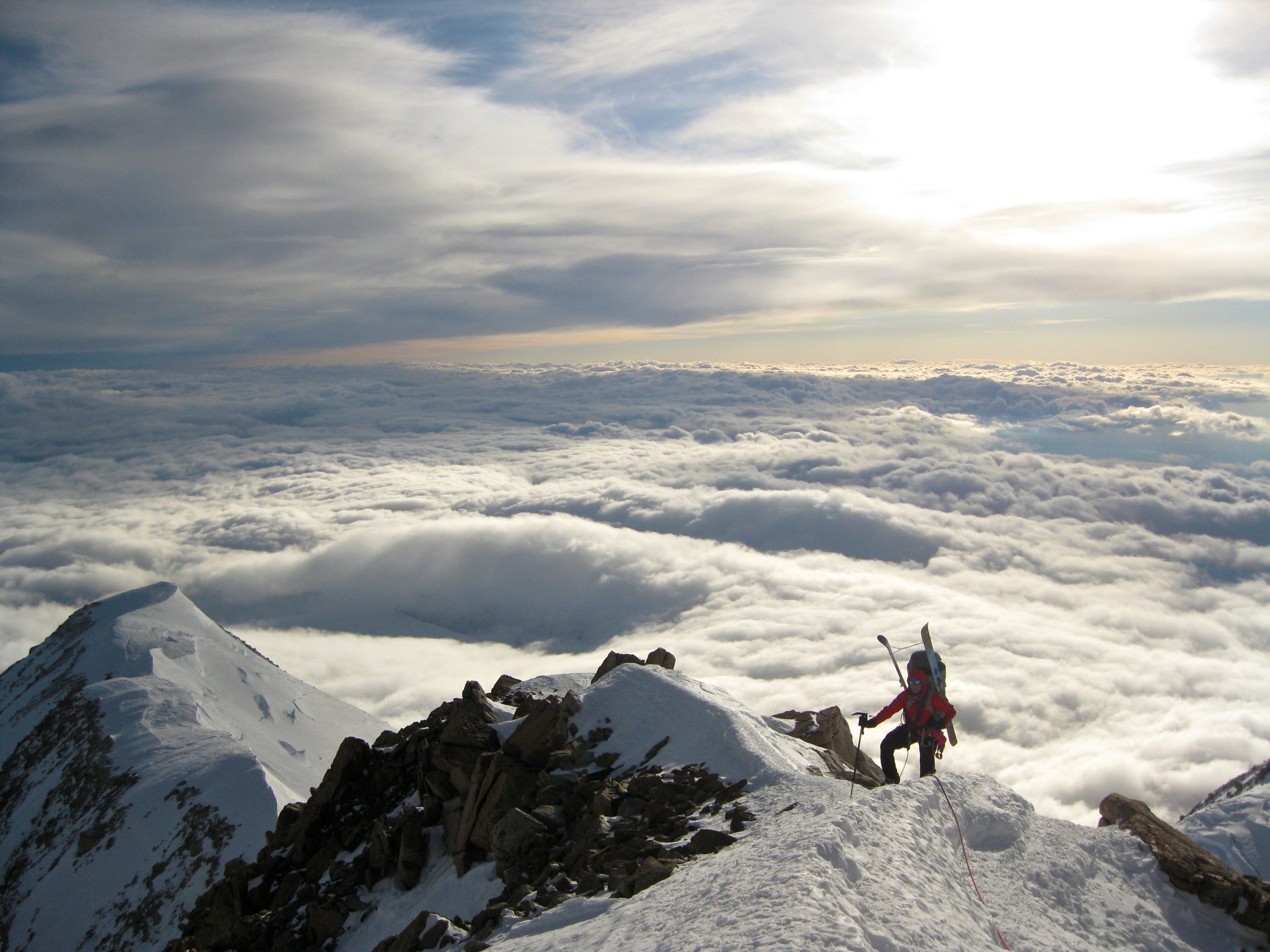
Above: Alpinist and former Freeski World Champion, Jessica Baker, Climbing the West Buttress of Denali before a ski descent.
By Rob Shaul
BLUF
A 2024 academic paper surveyed 200 studies on how nutrition, hydration, and supplements affect health and performance in high-altitude mountaineering.
The paper, Nutrition, hydration and supplementation considerations for mountaineers in high-altitude conditions: a narrative review, offers an evidence-based strategy for alpine climbers to mitigate the twin challenges of severe energy deficit and physiological stress at elevation.
Energy expenditure at high altitude can exceed 10,000 kcal/day, while intake often falls below 3,000 kcal/day. The result: rapid body-mass loss, reduced muscle function, impaired recovery, and cognitive decline.
The authors propose an optimal intake range of 40–70 kcal/kg body weight per day (≈2,000–7,000 kcal/day for most climbers), heavy in carbohydrates, moderate in protein, and supported by ample hydration.
Energy Expenditure at Altitude
The paper highlights how climbing at altitude produces enormous variability in daily energy cost — driven by altitude, slope, terrain, cold, and load carriage.
Using doubly labeled water studies and expedition data, the authors report the following daily caloric expenditure depending upon altitude.
Himalayas (5,300–8,848 m): 4,634–5,394 kcal/day
Cascade Range (2,500–3,100 m): ≈4,000 kcal/day
Cordillera Blanca (4,000–6,000 m): ≈4,560 kcal/day
Alps (2,400–3,800 m): up to 10,400 kcal/day during prolonged climbs
At these levels of work, energy expenditure can reach 1.85–3× sea-level rates.
What’s Burning Calories?
- Hypoxia – increases ventilation rate, heart rate, and resting metabolic rate (RMR).
- Cold exposure – stimulates thermogenesis (shivering and non-shivering), raising RMR by 10–30%.
- Load carriage and slope – each 1 kg carried raises energy cost ~1%; steep terrain can double per-minute expenditure compared to level walking.
- Sleep deprivation and stress hormones – elevate basal metabolism and impair appetite.
- Voluntary caloric restriciton. This can be caused by nasaua, upset stomach, lack of appetite, etc. Climbers often simply don’t consume enough calories.
Combined, these factors drive a sustained negative energy balance, leading to 3–15% bodyweight loss during multi-week climbs, most of it lean mass.
Recommended Macronutrient Strategy
Carbohydrates:
Base camp: 3–5 g/kg of bodyweight/day
Climbing/trekking: ≥6 g/kg of bodyweight/day
At extreme altitude, up to 60–65% of total calories.
Protein:
1.4–2.0 g/kg of bodyweight/day recommended; 1.6 g/kg of bodyweight/day during prolonged energy deficit.. Complete prevention of lean loss is unlikely at >5,000 m even with high intake.
Fat:
20–35% of calories (can reach 50% for long climbs).
Prioritize unsaturated sources (nuts, seeds, oils).
High fat increases energy density but may suppress appetite.
Hydration:
Fluid turnover increases sharply from hyperventilation and cold diuresis. Recommended is 4–5 L/day including sodium (0.5–1 g/L) to offset low-mineral glacier water. Thirst blunting and logistical constraints make dehydration common, impairing cognition and endurance
For a 70 kg mountaineer, based on these guidelines, a recommended high-altitude nutrition target is around 4,000 kcal/day, broken down roughly as 600 g carbs, 110 g protein, and 100 g fat — with carbs driving the bulk of the intake for oxygen efficiency and glycogen preservation.
Climbers typically consume only 30–70% of what they burn — often just 1,800–3,300 kcal/day, limited by appetite suppression, cold, time constraints, and logistical difficulty.
Takeaways
Mountaineering at altitude is an extended experiment in controlled starvation and hypoxia. Performance lies in energy management — anticipating caloric demand, maintaining carbohydrate availability, and staying hydrated despite environmental barriers.
Alpine climbers often operate a deficit of 3,000–6,000 kcal/day. Nutrition planning must be treated as seriously as acclimatization or load carriage.
Plan caloric intake around 40–70 kcal/kg (bodyweight)/day, aiming for energy sufficiency even during acclimatization. Favor carbohydrate-dominant, high-density foods that are easy to digest and thaw.
Hydrate deliberately and intentionally. Dehydration and electrolyte losses are underestimated at altitude and can lead to cognitive impacts on judgement.
Accept that some lean mass loss is unavoidable; focus on maintaining performance, not body weight.
Source:
Karpęcka-Gałka, E., & Frączek, B. (2024). Nutrition, hydration and supplementation considerations for mountaineers in high-altitude conditions: A narrative review. Frontiers in Sports and Active Living, 6, 1435494. https://doi.org/10.3389/fspor.2024.1435494.