
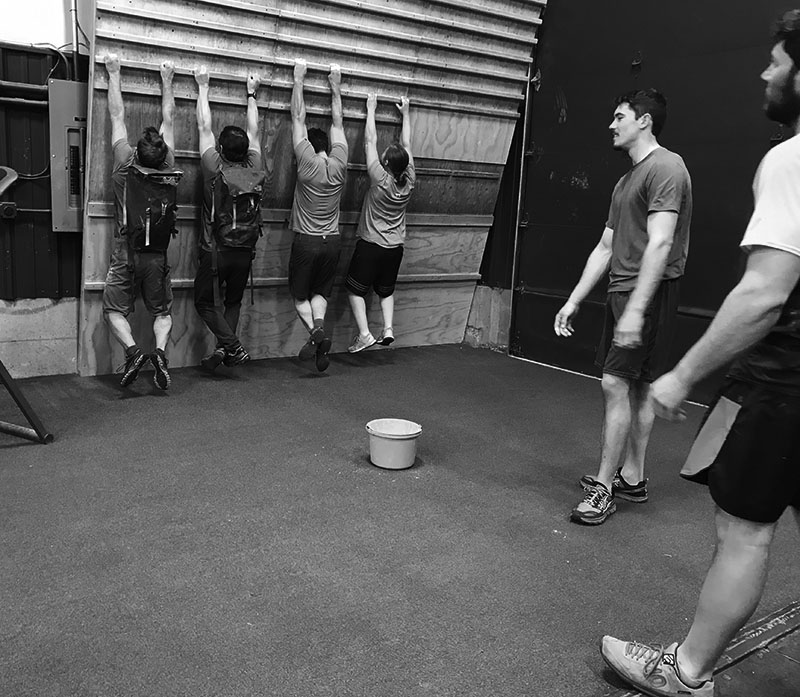
Above: MTI Rock Climb Lab Rats train finger strength endurance via campus board dead hang intervals.
By Rob Shaul
BLUF:
Climbing performance is determined almost entirely by trainable physical and endurance capacities—not by body type. In this study of 44 climbers ranging from 5.6 to 5.13c, strength and endurance variables explained nearly 60% of performance variance, while anthropometric traits like height, weight, and ape index explained less than 1%. The strongest predictors of performance were grip strength endurance, bent-arm hang time, and relative grip strength, all of which are trainable. Route performance was scored by the highest controlled handhold on standardized artificial climbs (5.7–5.13 difficulty). The findings clearly show that elite climbing ability arises from developed forearm endurance, upper-body strength, and climbing experience, not genetic body structure.
Overview
This foundational study by Mermier et al. (British Journal of Sports Medicine, 2000) remains one of the most detailed analyses of the physical and physiological determinants of climbing ability. The researchers sought to quantify exactly which variables best predict sport climbing performance — separating trainable characteristics like grip endurance and power from unchangeable anthropometric traits such as height, arm span, and body weight.
Forty-four climbers (24 men and 20 women) of widely varying ability — from 5.6 to 5.13c — completed standardized climbing routes and an extensive laboratory assessment. The goal was to determine which physical, physiological, and body composition factors most strongly correlated with actual climbing performance.
Climbing Performance Testing
Performance was measured on two artificial climbing routes constructed indoors to control for environmental variables.
- Route 1: 11 meters long, starting at 5.7 and gradually increasing to 5.12 difficulty.
- Route 2: 30 meters long, beginning at 5.9 and rising to 5.13.
Each climber ascended both routes on top rope, and performance was scored based on the highest handhold reached.
- Each handhold represented one increment of performance.
- The total number of handholds successfully grasped (and controlled for at least 3 seconds) served as the numerical climbing score, allowing continuous, quantifiable comparison across subjects.
- This system ensured that all participants were graded on both technical and endurance-based climbing effort rather than just maximum difficulty.
The routes were specifically designed to assess sustained climbing ability rather than bouldering-style power. Resting on the wall or weighting the rope resulted in termination of the attempt.
Physiological and Anthropometric Testing
After the climbs, each subject underwent an extensive battery of lab-based tests covering 25 total variables. These included:
1. Anthropometric Measurements
Height, body mass, body fat percentage (via skinfold calipers), arm span, leg length, and ape index (arm span-to-height ratio). These quantified the morphological traits commonly believed to influence climbing ability.
2. Strength and Power
- Grip strength and grip strength endurance were measured using a hand dynamometer.
- Grip strength was recorded as the maximal force generated by each hand (averaged across trials).
- Grip endurance involved maintaining 40% of that maximum force until failure.
- Isometric shoulder and knee extension/flexion strength were measured using a Cybex dynamometer.
- Upper-body power was assessed via the Wingate anaerobic test, measuring 30 seconds of maximal cycling power output.
3. Endurance and Aerobic Capacity
- Bent-arm hang time (holding a 90° elbow flexion position until failure).
- VO₂max, measured on a cycle ergometer using open-circuit spirometry.
- Grip endurance and bent-arm hang served as climbing-specific endurance proxies.
4. Flexibility
Hip flexion/extension and shoulder abduction range of motion, measured with a goniometer.
5. Training and Experience
Self-reported training frequency (sessions per week), years of climbing experience, and self-assessed ability rating (best redpoint grade) were also recorded.
Statistical Analysis
To identify the main contributors to performance, the researchers used principal components analysis (PCA) to condense the 25 variables into three overarching factors:
- Training Component – representing strength, endurance, power, and climbing experience.
- Anthropometric Component – representing body size and composition.
- Flexibility Component – representing joint range of motion.
These factors were then entered into a multiple regression model to predict climbing performance scores.
Results
The regression model explained 66.3% of the total variance in climbing performance. The breakdown:
- Training Component: 58.9% of variance explained.
- Anthropometric Component: 0.3% of variance explained.
- Flexibility Component: 1.8% of variance explained.
- The remainder (≈39%) was attributed to psychological, technical, or unmeasured variables.
This meant that performance was overwhelmingly determined by trainable attributes — particularly those related to strength and endurance.
Within the training component, the most predictive individual variables were:
- Grip strength endurance (r = 0.76, p < 0.001)
- Bent-arm hang time (r = 0.68, p < 0.001)
- Relative grip strength (normalized to body mass) (r = 0.64, p < 0.01)
- Self-rated climbing ability (r = 0.70, p < 0.001)
- Years of climbing experience (r = 0.55, p < 0.01)
By contrast, anthropometric measures like height, weight, ape index, and even body fat percentage showed little to no correlation with actual climbing performance. Even variables often mythologized in climbing culture — such as having long arms or low body weight — were statistically insignificant once training factors were accounted for.
Discussion
The study dismantled several persistent myths about climbing performance. Despite widespread belief that lighter, lankier climbers have a structural advantage, body proportions explained less than 1% of variance. Climbing-specific endurance (as measured by grip endurance and bent-arm hang) emerged as the single strongest predictor of performance. This underscores that sport climbing is primarily a strength-endurance activity, not a strength or power sport.
The authors suggested that elite climbers’ characteristic physiques — lean, muscular upper bodies and low body fat — likely result from years of training rather than innate traits. They also hypothesized that the unexplained variance (around 34%) likely reflects psychological and technical skill, including route-reading ability, pacing, and composure on difficult sequences.
Practical Implications
For coaches and athletes, this study provides a clear blueprint for training focus:
- Prioritize climbing-specific endurance — high-rep grip and bent-arm holds, finger grip strength and strength endurance, and route endurance sessions.
- Train relative strength — improving the ability to produce and maintain high force relative to body weight.
- De-emphasize anthropometric “limitations.” Height, weight, and ape index are negligible predictors of performance once strength and endurance are developed.
- Include experience and skill-based work. Time on rock and route familiarity remain critical elements of performance progression. The Bouldering V-Sum is a perfect training tool as it concurrently trains grip/finger strength endurance and technique.
Mermier et al.’s research established that climbing performance is built, not inherited. The defining features of successful climbers are trainable, not anatomical. Grip strength endurance and upper-body isometric strength are the strongest physiological predictors of success, while body type and flexibility play minor roles.
In short, elite climbing ability arises from developed strength-to-weight ratio, muscular endurance, and years of structured training — not genetics or morphology.
Citation:
Mermier, C. M., Janot, J. M., Parker, D. L., & Swan, J. G. (2000). Physiological and anthropometric determinants of sport climbing performance. British Journal of Sports Medicine, 34(5), 359–366. https://doi.org/10.1136/bjsm.34.5.359