
By Rob Shaul
Overview
Two studies analyzed the biomechanics and physiology of ski mountaineering ascent. Both explored how slope angle, speed, and mechanical factors influence energy cost, efficiency, and optimal pacing. Together, they provide a clearer understanding of what “efficient climbing” actually means in ski mountaineering and how gradient, stride, and pacing interact to define performance.
Study 1: Optimal Slopes and Speeds in Uphill Ski Mountaineering (Praz et al., 2016)
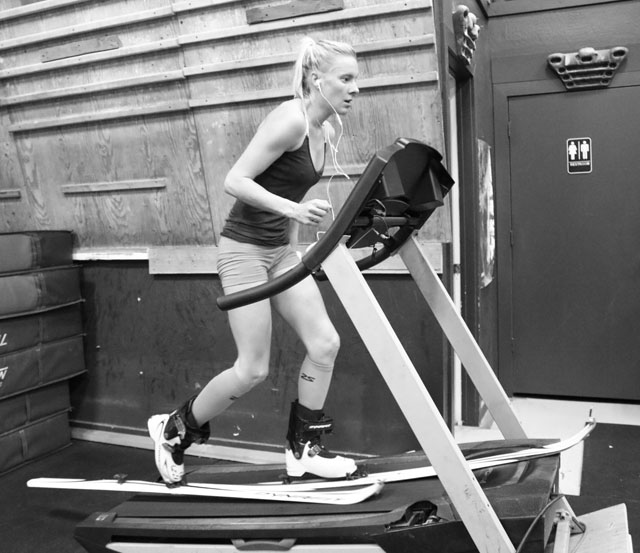
This laboratory-based study examined the physiological and mechanical efficiency of ski mountaineering across three gradients—10%, 17%, and 24%—and three speeds corresponding to roughly 70%, 80%, and 85% of peak heart rate. Twelve trained ski mountaineers performed treadmill roller-skiing while researchers measured oxygen consumption, heart rate, stride frequency, stride length, and mechanical efficiency through indirect calorimetry and inertial motion sensors .
Findings:
- At shallower gradients (10%), energy cost per distance (EC) remained constant across speeds.
- At steeper gradients (17% and 24%), faster speeds became more economical—suggesting that higher power outputs are metabolically efficient on steep terrain.
- The steepest slope (24%) was the most economical overall, producing the lowest energy cost per vertical meter climbed.
- With increased gradient, stride length shortened while the relative thrust phase duration (the proportion of each stride spent pushing) lengthened.
- At faster speeds on steep slopes, athletes compensated with higher stride frequency and longer strides, combining efficient force transfer and reduced contact time.
Ski mountaineers can minimize energy expenditure by maintaining fast speeds (~6 km/h) on steep gradients (~24%), assuming adequate aerobic capacity. This runs counter to intuitive pacing—where many slow down excessively on steep terrain—and supports a deliberate “power-climb” approach in advanced athletes.
Study 2: Biomechanical and Physiological Determinants of Ski Mountaineering (Formenti et al., 2025)
The second study built on earlier lab work by testing real ski mountaineering conditions, integrating kinematic, metabolic, and mechanical variables to explore efficiency determinants. Using instrumented treadmills and portable metabolic systems, researchers analyzed how ski boot setup, gradient, and individual technique influence mechanical power and efficiency.
Findings:
- Uphill ski mountaineering demands exceptionally high mechanical efficiency, comparable to or exceeding uphill running and diagonal cross-country skiing.
- Optimal climbing performance depends on maintaining a rhythm that balances stride length, cycle frequency, and pole thrust timing.
- Efficiency declined when either speed or stride frequency deviated substantially from self-selected “preferred” rhythms—highlighting that ski mountaineering efficiency depends as much on technique as physiology.
- Ski boots with lower cuff stiffness and lighter mass slightly improved mechanical efficiency by reducing distal leg inertia—though effects were minor compared to gradient and stride rhythm.
- At extreme inclines (>20%), vertical mechanical efficiency improved, but horizontal energy cost increased—indicating that mechanical coordination, not slope alone, drives overall performance.
Summary
Together, these studies converge on a key principle: efficiency in uphill ski mountaineering is achieved through synchronization of gradient, stride mechanics, and metabolic power. Steeper slopes (around 24%) appear most economical, provided athletes maintain high stride frequency and short contact phases. However, optimal rhythm—not maximal intensity—dictates energy cost.
Whereas Praz et al. identified the metabolic “sweet spot” of slope and speed, Formenti et al. highlighted that deviations from preferred technique rhythm—even with optimal gradient—rapidly reduce mechanical efficiency. Thus, ski mountaineers should train both steep-gradient aerobic capacity and technical rhythm consistency under varied loads and snow conditions.
Takeaways:
- Climb Steep and Steady: Around 24% gradient with a brisk but controlled pace (~6 km/h) minimizes energy cost per vertical meter.
- Focus on Rhythm: Efficiency depends on repeatable stride timing and pole thrust rhythm—small deviations increase metabolic cost.
- Boot and Equipment Setup: Light, flexible boots marginally improve efficiency by reducing inertial drag but don’t replace proper pacing mechanics.
- Training Application: Endurance training for ski mountaineering should include steep uphill intervals at competition-specific speeds to improve efficiency at high power outputs.
Sources:
Praz, C., Fasel, B., Vuistiner, P., Aminian, K., & Kayser, B. (2016). Optimal slopes and speeds in uphill ski mountaineering: a laboratory study. European Journal of Applied Physiology, 116(5), 1011–1019.
Formenti, D., et al. (2025). Physiological and Biomechanical Determinants of Uphill Ski Mountaineering Efficiency.Applied Sciences, 15(3), 1003.