
By Seung Choi, MTI Intern
Throughout my academic journey—from earning my bachelor’s in exercise science at Temple University to pursuing my master’s at the University of Colorado Colorado Springs—one principle was consistently reinforced: carbohydrates are essential for high-intensity performance. While explosive and strength-based movements primarily draw on phosphocreatine (PCr) for energy, this energy system is quickly depleted. As athletes push through repeated high-intensity sets, the body begins to rely heavily on muscle glycogen—carbohydrate stored in the muscle—to continue performing explosively. This understanding is foundational in exercise physiology.
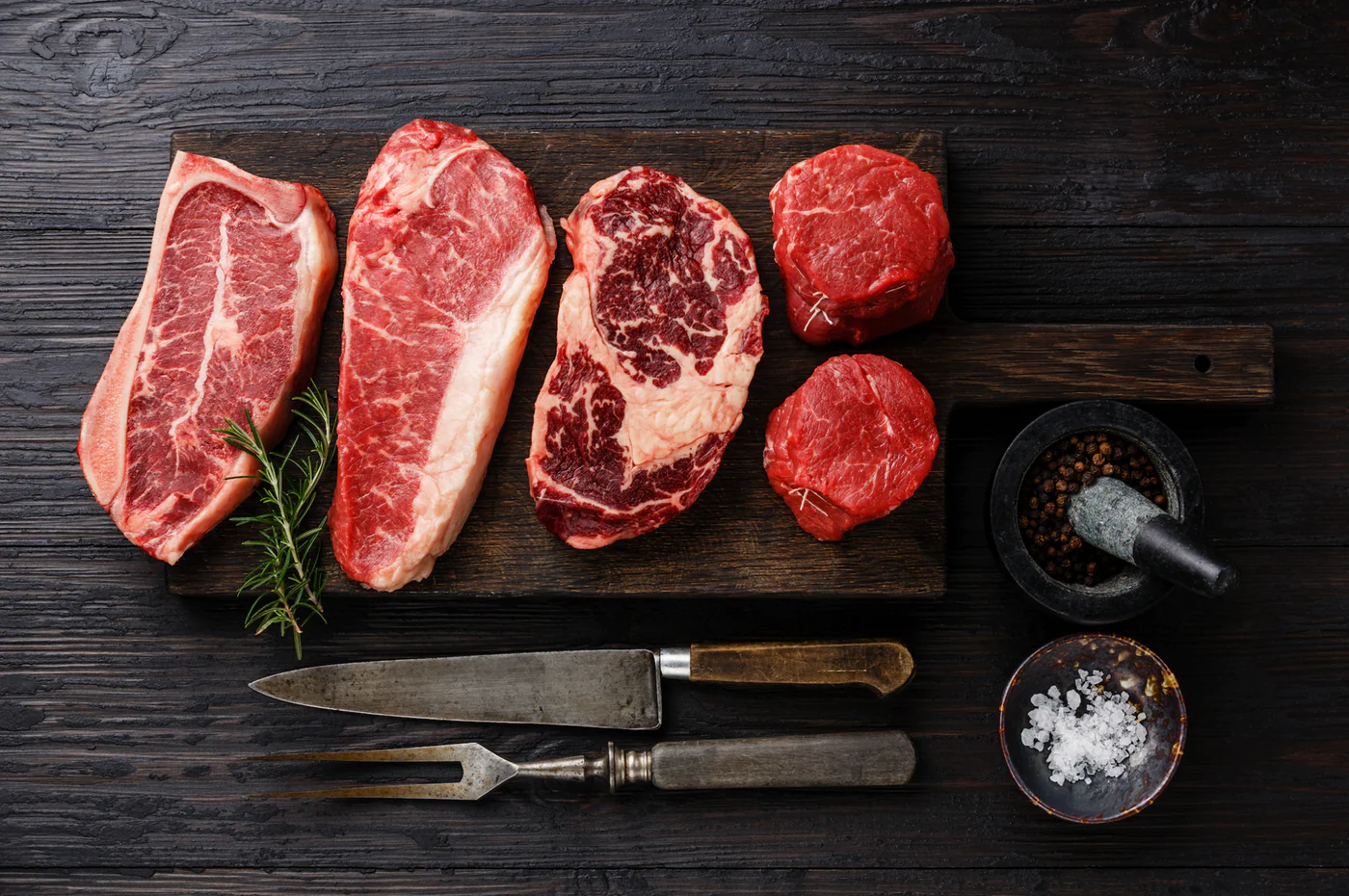
But that foundation was challenged the moment I arrived at Mountain Tactical Institute (MTI). For the first time in my life, I encountered not one, but two individuals following strict carnivore diets—consuming only animal-based foods, virtually no carbohydrates. What surprised me more than their diet was their performance. Despite my academic background, they reported maintaining or even increasing their strength levels while on carnivore.
I’m not the type to blindly believe a textbook; however, this didn’t make sense to my understanding of how the body fuels strength and power. What I was seeing in real life just didn’t align with what I had been taught in both undergrad and grad school. Something wasn’t adding up.
So in this article, I want to examine the effects of the carnivore diet on strength performance, using both the principles of exercise physiology and the lived experiences of athletes I’ve trained alongside.
In explosive work—from power cleans, backsquats to 100m sprints—the phosphocreatine (PCr) system is our go-to source for immediate power. PCr is incredibly fast, providing near-instant energy, but it only lasts about 10–30 seconds per bout. The good news is it replenishes quickly, often within a minute or two. However—and this is key—it never fully recharges between efforts. As athletes push through multiple sprints or heavy lifting sets, the PCr pool becomes chronically underfilled, and that’s when the body increasingly taps anaerobic glycolysis, using muscle glycogen—the carbohydrate stored inside muscles—for explosive force.
Muscle glycogen is a powerhouse during high-intensity activity. It can fuel ATP production at rates of around 40 mmol/kg wet weight per minute, far surpassing what blood glucose can provide. Multiple studies on team sports and interval training confirm that repetitive sprints or power-based movements rapidly deplete both PCr and glycogen, and that replenishing these stores via carbohydrate intake is essential to maintain performance across successive bouts. While PCr can partially recover between efforts, glycogen becomes increasingly important as sessions continue. Without sufficient carbohydrate availability to replenish these energy stores, performance begins to decline—especially as the duration of training increases.
The carnivore diet eliminates nearly all carbohydrate intake, focusing exclusively on animal-based foods. While this appears to remove the primary energy source for high-intensity efforts, the body is remarkably adaptable. Through a process called gluconeogenesis, the liver can synthesize glucose from non-carbohydrate substrates such as amino acids, lactate, and glycerol. In theory, this allows the body to function without dietary carbohydrates. However, the capacity of gluconeogenesis is limited. During intense exercise, muscle glycogen can be broken down at rates approaching 40 mmol/kg/min, whereas gluconeogenesis operates much slower (van Loon et al., 2001)—typically only 1–2 mmol/kg/hour in the absence of dietary carbohydrate (Berg et al., 2015; Areta & Hopkins, 2018). This mismatch creates a significant problem: the body burns through glucose in minutes, but requires hours or even days to rebuild what was lost.
A real-world example comes from a recent case study involving a female Division II soccer player who followed a strict carnivore diet. Initially, she performed adequately, but data revealed that her body was working disproportionately hard to maintain performance. Her TRIMP score—a metric used to quantify training load—was 240, well above her teammates’ average of 205. After she introduced a small carbohydrate intake of 16 grams pre-game and 6 to 10 grams post-game, her TRIMP dropped to 208, placing her much closer to the team average. This change suggests that even a minimal amount of carbohydrate intake helped her body perform more efficiently and recover better under the same workload.
Research supports this pattern. Systematic reviews and performance trials have shown that while maximal strength (such as one-rep max efforts) may be preserved on low-carbohydrate diets (Volek et al., 2006; Wilson et al., 2017), performance in explosive or high-volume training often declines—especially when efforts are repeated over time. Athletes on low-carb regimens tend to rely more heavily on fat oxidation, which is adequate for lower-intensity efforts but falls short when rapid glycolytic output is required. Strategic carbohydrate intake, even in small amounts—ranging from 15 to 40 grams around training—has been shown to restore performance without requiring athletes to fully abandon a low-carb or carnivore-style diet (Kerksick et al., 2018).
Relying entirely on gluconeogenesis to meet carbohydrate needs has several downsides. First, glycogen replenishment between intense sessions becomes sluggish, reducing recovery capacity. Training quality may suffer, especially in terms of explosiveness, volume tolerance, and repeatability. Since amino acids are a primary substrate for gluconeogenesis, protein requirements increase and may result in muscle breakdown if dietary intake doesn’t compensate. Furthermore, chronic underfueling can elevate cortisol levels and lead to increased fatigue and hormonal stress. While these consequences may be manageable for lifestyle or recreational training, they often become limiting for athletes engaged in competitive, high-demand strength programs.
Many athletes on carnivore or ketogenic diets implement tactical solutions rather than abandoning the diet altogether. One common method is the Targeted Ketogenic Diet (TKD), where carbohydrates are consumed only around training sessions—often using easily digestible sources like honey, fruit, or dairy. Another approach is cyclic carbohydrate refeeds, where higher carb days are scheduled every few days to restore glycogen levels. Others align their carbohydrate intake with the training cycle, increasing intake on high-volume or high-intensity days. These strategies help preserve strength, explosiveness, and performance while retaining many of the benefits associated with a low-carb or carnivorous lifestyle.
In the end, carbohydrates are not the enemy—but they remain one of the most efficient fuels for high-intensity, glycolytic performance. The carnivore diet challenges the body to become metabolically flexible, and it may work for certain goals. However, when the training demands increase in duration, density, or explosiveness, glucose still rules the track, barbell, and field. If you’re lifting heavy, sprinting hard, or logging long sessions, it may be wise to fuel your training intensity—not just your dietary ideology.
References
Areta, J. L., & Hopkins, W. G. (2018). Skeletal muscle glycogen content at rest and during endurance exercise in humans: A meta-analysis. Sports Medicine, 48(9), 2091–2102. https://doi.org/10.1007/s40279-018-0940-7
Berg, J. M., Tymoczko, J. L., & Stryer, L. (2015). Biochemistry (8th ed.). W.H. Freeman.
Kerksick, C. M., Wilborn, C. D., Roberts, M. D., Smith-Ryan, A., Kleiner, S. M., Jäger, R., … & Kreider, R. B. (2018). ISSN exercise & sports nutrition review update: research & recommendations. Journal of the International Society of Sports Nutrition, 15(1), 38. https://doi.org/10.1186/s12970-018-0242-y
van Loon, L. J., Greenhaff, P. L., Constantin-Teodosiu, D., Saris, W. H., & Wagenmakers, A. J. (2001). The effects of increasing exercise intensity on muscle fuel utilisation in humans. The Journal of Physiology, 536(1), 295–304. https://doi.org/10.1111/j.1469-7793.2001.00295.x
Volek, J. S., Sharman, M. J., Gómez, A. L., Scheett, T. P., Kraemer, W. J. (2006). An isoenergetic very low carbohydrate diet improves serum HDL cholesterol and triacylglycerol concentrations, the total cholesterol to HDL cholesterol ratio and postprandial lipemic responses compared with a low fat diet in normal weight, normolipidemic women. The Journal of Nutrition, 133(9), 2756–2761. https://doi.org/10.1093/jn/133.9.2756
Wilson, J. M., Lowery, R. P., Roberts, M. D., Sharp, M. H., Joy, J. M., Shields, K. A., … & Naimo, M. A. (2017). The effects of ketogenic dieting on skeletal muscle and fat mass. Journal of the International Society of Sports Nutrition, 14(1), 1–9. https://doi.org/10.1186/s12970-017-0173-0