
By Jackson Mann
BLUF (Bottom Line Up Front)
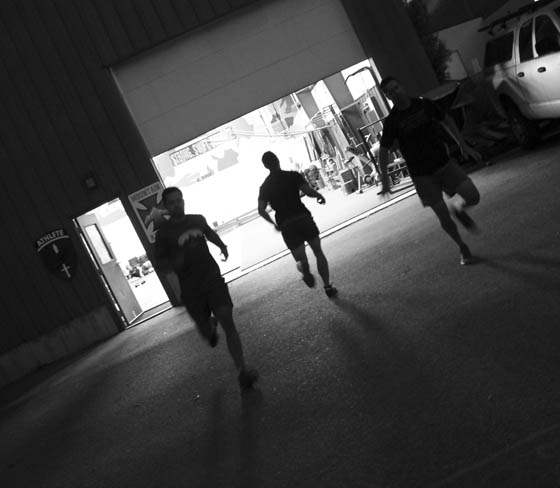
Four MTI Lab Rats completed a 5-week mini-study comparing two methods of improving 20m Beep Test performance: MTI’s traditional assessment-based progression and a fixed-time, non-assessed interval progression. All athletes improved, with an average gain of +1.35 levels. The highest individual improvement came from athletes using the non-assessment based model.
Key Outcomes:
- Emmett (Assessment-Based): +1.3 levels (7.10 – 9.1)
- Sam (Assessment-Based): +1.0 level (10.1 – 11.1)
- Jackson (Non-Assessed Intervals): +1.5 levels (9.1 – 11.3)
- Seung (Non-Assessed Intervals): +1.6 levels (5.5 – 7.1)

Background
The 20m Beep Test, also known as the Multi-Stage Fitness Test (MSFT), is one of the most widely used field assessments for aerobic capacity and repeat sprint ability across military, law enforcement, and athletic populations. The test involves continuous 20-meter shuttle runs paced by increasing audio cues until voluntary exhaustion or failure to meet the pace. It is validated as a reliable predictor of VO₂ max (Léger et al., 1988) and is a cornerstone of aerobic assessment in militaries such as the British Army, Canadian Armed Forces, and Australian Defence Force.
Public safety agencies commonly employ structured, progressive training plans to prepare candidates for the 20m Beep Test. The Queensland Fire Department uses a 3-day-per-week program that blends maximal aerobic speed intervals, steady-state running, and short sprint conditioning to build aerobic capacity and repeat sprint ability. The Metropolitan Police Service offers a 6-week schedule alternating between hard and easy days, incorporating warm-ups, steady runs, and bodyweight circuits to improve both aerobic fitness and general conditioning. Meanwhile, the Tasmania Police deploy a 5-day-per-week plan combining middle-distance runs, interval sessions, steady-state cardio, and dedicated rest and strength training days. Each program prioritizes consistency, progressive overload, and a mix of intensities to develop aerobic endurance, speed recovery, and physical resilience for the demands of the Beep Test.
MTI’s current model uses an assessment-based progression that adjusts sprint volume based on each athlete’s performance. While this method has performed well, it has not been re-tested in a direct comparison to a simplified, fixed-interval approach.
This Geek Cycle study tested both methods. The goal was to determine whether individualized progressions truly offer superior results or whether a standardized approach might yield comparable outcomes in a shorter or less resource-intensive format.
Study Design
Participants
- Assessment-Based Progression: Sam and Emmett
- Fixed-Interval Progression: Jackson and Seung
Assessments
- Beep Tests conducted at Initial, mid-cycle, and end of cycle assessments (best effort to failure).
Training Progressions (3x/week)
Weeks 1–2
Assessment Group (MTI Model)
- Sprint volume scaled to 140–150% of Beep Test score using MTI’s Shuttle Sprint Chart.
- Emmett (7.10): 10.5 reps per 2-min round
- Sam (10.1): 12.0 reps per 2-min round
- Completed 10 total rounds each session; all reps completed each time.
Interval Group
- Week 1: 60s sprint / 60s rest
- Week 2: 70s sprint / 50s rest
Weeks 3–4
- Assessment Group: Sprint volume increased based on mid-cycle reassessment
- Interval Group: 80s sprint / 40s rest
Week 5
- Final Beep Test reassessment conducted for all athletes.
MTI’s 20M SHUTTLE SPRINT INTERVAL CHART
One 20m length = 1 rep. Set up a 10m cone halfway for half-rep prescriptions (e.g., 11.5 reps = 11 full + one 10m rep).
| Beep Test Score | Reps Every 2 Min (x10 Rounds) |
| 5.0 – 5.9 | 9.5 reps |
| 6.0 – 6.10 | 10.0 reps |
| 7.0 – 7.10 | 10.5 reps |
| 8.0 – 8.11 | 11.0 reps |
| 9.0 – 9.11 | 11.5 reps |
| 10.0 – 10.11 | 12.0 reps |
| 11.0 – 11.12 | 12.5 reps |
| 12.0 – 12.12 | 13.0 reps |
| 13.0 – 13.13 | 13.5 reps |
| 14.0 – 14.13 | 14.0 reps |
| 15.0 – 15.13 | 14.5 reps |
| 16.0 – 16.14 | 15.0 reps |
Results
| Athlete | Progression Type | Initial | Mid | Final | Change (Initial → Final) |
| Sam | MTI Assessment-Based | 10.1 | 10.2 | 11.1 | +1.0 |
| Emmett | MTI Assessment-Based | 7.10 | 8.6 | 9.1 | +1.3 |
| Jackson | Fixed-Interval | 9.10 | 11.1 | 11.3 | +1.5 |
| Seung | Fixed-Interval | 5.5 | 6.5 | 7.1 | +1.6 |
Average Improvement Across All Athletes: +1.35 levels
Discussion
All four athletes improved their Beep Test scores over the 5-week cycle, reinforcing that both progression models can enhance aerobic capacity and repeat sprint ability. Athletes using the MTI assessment-based progression—Emmett and Sam—showed steady gains with structured, individualized workloads tied directly to their baseline capacity. Furthermore, both were able to complete their designated reps each round while feeling a high RPE, indicating that the assessment based progression was aptly scaled to their individual abilities and limits. This tailored approach likely helped manage fatigue while still driving adaptation.
Meanwhile, Seung and Jackson—who trained with the non-assessment-based interval model—also saw significant improvements. Jackson’s increase of +1.5 levels and Seung’s +1.6 represented the two largest gains in the group, suggesting that fixed intervals can still be highly effective, particularly for athletes with lower initial scores or less exposure to structured sprint-aerobic work.
It’s worth noting that Jackson’s initial Beep Test score may have underestimated his true capacity. During the initial assessment, he experienced quad cramping and stopped before reaching his physiological threshold. This likely deflated his baseline score, making his final result appear more dramatic than it otherwise would have been. While his +1.5 level gain is valid, it must be interpreted in light of that compromised starting point. His mid- and final assessments more accurately reflect his aerobic ability and repeat sprint tolerance under normal conditions.
Limitations
As with other Geek Cycle studies, this trial was limited by its small sample size (n=4) and lack of a control group. With only two athletes per progression type, it is difficult to draw broad conclusions or account for outlier responses. Individual factors such as baseline aerobic conditioning, running economy, and prior sprint exposure likely influenced each athlete’s rate of improvement. Additionally, all participants were engaged in concurrent training studies, adding variables that may have impacted fatigue, performance, or recovery. While the fixed-interval model showed strong short-term gains, further testing is needed to determine whether these results hold over longer cycles or in more advanced populations.
Next Steps
Future progressions may explore hybrid protocols—starting with fixed-time intervals to establish aerobic capacity, then transitioning into individualized, assessment-based sprints to target higher-intensity adaptations.
Another avenue for exploration is a comparison between a Zone 2 run progression and a non-assessment Beep Test protocol. While both are aimed at improving aerobic capacity, they differ significantly in intensity distribution and fatigue profile.
These next steps aim to refine MTI’s sprint-aerobic prescription model and clarify the most effective, scalable methods for building aerobic capacity across diverse populations and operational needs.
References
- Queensland Fire and Emergency Services. (2022). Beep Test training program. Queensland Government.
- Metropolitan Police Service. (n.d.). Training programme: Preparing for your fitness test.
- Tasmania Police Recruitment. (2024). Beep test training program.